

YOUR CART IS EMPTY
Go to cart
Advanced driver-assistance systems now sit behind nearly every windshield you replace. The cameras, radar units, and sensors that power lane-departure warnings and automatic emergency braking need recalibration after common repairs, and shops that can't do that work in-house are handing revenue to competitors. This guide breaks down what ADAS calibration equipment actually costs, how the systems differ, and how to pick the right setup for an independent glass shop, not a 20-bay collision center.
Every time you remove and reinstall a windshield with a forward-facing camera, that camera's aim shifts. Even a fraction of a degree changes where the vehicle "sees" the road. Skip the calibration and the customer drives away with a lane-keeping system that steers a few inches off center or an automatic braking system that reads distances wrong.
The liability is real. If a vehicle you serviced fails to brake because a camera was never recalibrated, your shop is exposed. Manufacturers and insurers increasingly require documented calibration after glass work, and "we didn't have the equipment" is not a defense.
Most independent shops start by subletting calibration to a dealer or a mobile specialist. That works until you count the money leaving the building. Whatever you currently pay per sublet job is money that stays in your bay once you bring the work in-house, and the customer's car and the follow-up work stay with you too.
Every ADAS system calibrates one of two ways, and the equipment you need depends on which methods the vehicles you service require.
Static calibration happens in the shop. You position the vehicle in front of a calibration frame holding printed targets or reflectors at precise distances and heights, then run the procedure through a diagnostic tablet. Many forward-facing camera systems, including lane-departure warning cameras on a wide range of domestic and Asian models, use static calibration. This method demands a controlled environment: level floor, consistent lighting, and enough clear space around the vehicle.
Dynamic calibration happens on the road. After connecting a scan tool, the technician drives the vehicle at a set speed on marked roads while the car's system calibrates itself using real-world lane lines and traffic. Some radar-based systems and certain European models rely on dynamic procedures. No targets are involved, but you still need the diagnostic tablet to initiate the drive cycle and confirm completion.
Plenty of vehicles need both. A single model might call for a static camera calibration in the bay followed by a dynamic drive cycle to finish. A shop that wants to service a broad range of makes needs equipment that supports static and dynamic procedures, plus a scan tool that runs the OEM-specific steps for each. Always work from the OEM service procedure for the specific vehicle in front of you; that document, not the tool, defines what the calibration requires.
ADAS calibration equipment spans a wide range, from target-and-pattern packages in the low four figures to complete all-systems setups above $20,000. The useful way to read that range is by what each tier actually lets you calibrate. The prices below are GT Tools list prices checked on August 19, 2026; confirm current pricing on each product page before you order.
Entry-level packages suit shops doing a handful of calibrations a week, mobile glass installers, or owners who want to test the market without a major capital commitment. These setups focus on the most common work behind a windshield job: forward-facing camera and lane-departure calibration.
On the GT Tools site, the ADAS calibration tools collection includes this tier. The Autel ADAS Lane Departure Package 3 lists at $1,540, Lane Departure Package 2 at $2,170, and Lane Departure Package 1 at $3,195. These are target and pattern sets that pair with a calibration frame and a diagnostic tablet, both purchased separately, so price the full setup rather than the package alone.
This is the natural starting point for ADAS calibration equipment for independent auto glass shops that want to stop subletting without gambling on a five-figure machine.
Mid-range systems fit shops with a steady calibration workflow that plan to expand what they can service. At this level you move from a single target set to broader coverage across radar, night vision, and around-view monitoring on more makes.
The Autel ADAS Calibration Package 1, listed at $7,885, is a good example. It bundles a center axis laser, radar calibration plate, box and corner reflector with stand, night vision calibrator and box, rear collision warning patterns for Nissan, Volkswagen, and Mercedes, and around-view monitoring patterns for Cadillac, Honda, and Volkswagen. It includes a one-year warranty and is compatible with an Autel ADAS calibration frame, which is not included.
Shops working from a smaller budget at this tier can look at Autel ADAS Calibration Package 2 at $3,399 or Package 4 at $3,610, then add expansion packages as the work comes in: the Autel Standard Frame Radar Calibration Expansion Package at $4,104, or the Autel Standard Frame AVM Camera Calibration Package at $6,203.
Comprehensive systems make sense for shops running high calibration volume or planning to become the local ADAS authority. These packages add camera, radar, night vision, and LiDAR coverage across nearly every make on the road.
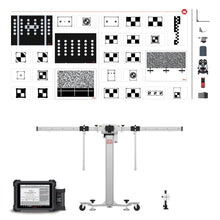
The Autel MAS20 MA600 All Systems Calibration Pack is built for this. It pairs the MA600 mobile frame with targets, patterns, and components for camera, radar, night vision, and LiDAR calibration, plus an ADAS software upgrade, backed by the manufacturer's one-year limited warranty. It was listed at $23,485 on October 10, 2026.
The math is simpler than the sticker price suggests, and you already have the two numbers you need. The first is what you currently pay to sublet a calibration, which is on your own invoices. The second is how many calibrations you send out in a normal week.
Run those through two formulas:
1. Calibrations per week × your current sublet cost per job = weekly spend you stop sending out
2. Equipment cost ÷ that weekly figure = weeks to payback
A worked example using GT Tools pricing: a mobile installer subletting three calibrations a week at whatever the local rate runs will pay off a $1,540 lane-departure target package far faster than a shop at the same volume paying off a $22,458 all-systems package. The tier decision is really a question of how much of your vehicle mix each package lets you keep in-house, not which one has the shortest payback in isolation.
Two things to build into the number before you commit. First, the target or pattern package is rarely the whole cost; most pair with a calibration frame and a diagnostic tablet sold separately. Second, once the equipment is paid off, you keep the full margin on every calibration after that, and you keep the customer in your bay for the rest of the job.
Choosing an ADAS calibration system comes down to matching the equipment to the vehicles you service and the way your shop works. Run through these criteria before you buy.
Start with your own data. Pull your recent repair orders and see which makes actually roll through your bay. A shop in a domestic-heavy market has different needs than one servicing a lot of European vehicles.
Coverage should span domestic and import manufacturers and handle both current model years and the older vehicles you will keep seeing for years [2]. Look for a system whose vendor updates its vehicle database regularly and is clear about which makes it adds next. Launch Tech's radar-focused compact systems cover European, Asian, and domestic vehicles for radar-based ADAS [3], but verify that breadth against your actual vehicle mix rather than the marketing. GT Tools carries the Launch Tech X-431 ADAS Mobile Package at $8,996.39 if that platform fits your shop better than Autel.
The faster a single tech can set up a calibration, the more jobs the shop clears. Manual systems rely on tape measures to position the frame relative to the vehicle. Optical and laser positioning tools do that automatically and cut the room for human error.
Static calibration needs room around the vehicle and a level floor, so measure your bay before you commit. A dedicated ADAS bay is ideal but not required for most glass-shop volumes.
Portability solves the space problem for smaller operations. Autel describes the MA600 as the number one selling mobile ADAS system in North America, built on a collapsible aluminum frame with centering lasers and target sets [1]. It lists at $9,600. If you want the frame and the tablet together, the Autel MaxiSys MA60020T ADAS Mobile Calibration Frame ships with an MS909S2 tablet at $11,585. For mobile glass installers or shops sharing a bay with other work, a portable frame is often the smarter choice than a fixed installation.
Calibration gear takes daily handling, so build quality protects your investment. When you compare systems, weigh target material, since laminated targets hold up better than printed ones; frame construction in aluminum versus steel; storage that keeps targets from warping or scratching; and the cost of replacement parts. A frame and target set that survives years of shop use is cheaper over its life than a bargain system you replace early.
The frame and targets are only half the job. You also need a diagnostic tablet to turn on the vehicle's calibration mode and run the OEM procedure. Some packages bundle one: the Autel MaxiSys MA60020T mobile frame includes an MS909S2 tablet. Target and pattern packages, and the MAS20 MA600 All Systems pack, expect you to supply a MaxiSYS tablet separately. GT Tools also lists the Autel MS906MAX with ADAS upgrade at $2,590 and the Autel ADAS Software Upgrade at $995 for shops adding calibration capability to a tablet they already own. Confirm whether a tablet is bundled or whether your existing scan tool is compatible before you buy, so the total cost is clear.
Factor in the total cost of ownership. Look for setup help, ongoing technical support, regular software updates, and solid warranty coverage. Autel notes that an IA700 purchase may include in-shop setup and training performed by an ADAS expert. GT Tools packages ship with warranty coverage, including the one-year warranty on the ADAS Calibration Package 1 and the MAS20 MA600 All Systems pack, plus free shipping, and the team can walk you through which components you need.
GT Tools® has been building durable, easy-to-use tools for auto glass technicians since 1984, and the ADAS lineup is built for independent shops rather than mega collision centers. You can browse the full ADAS calibration tools collection, but here are three ways to match a package to your needs.
• For a first move off subletting: The Autel ADAS Lane Departure packages start at $1,540 and cover the forward-facing camera work that follows most windshield jobs. Pair with a frame and tablet.
• For broader in-shop coverage: The Autel ADAS Calibration Package 1 at $7,885 adds radar, night vision, and around-view monitoring patterns across more makes, with a one-year warranty.
• For comprehensive all-systems service: The Autel MAS20 MA600 All Systems Calibration Pack at $23,485 covers camera, radar, night vision, and LiDAR, for shops aiming to become the local ADAS expert.
Follow the OEM service procedure for the specific vehicle. Many vehicles with a forward-facing camera mounted to the windshield require calibration after the glass is removed and reinstalled, because the camera's aim shifts with the mount. The procedure, not the tool or the shop, defines the requirement, so check it per vehicle and document what you did.
It depends on your vehicle mix. Static calibration needs a frame, targets, and controlled shop conditions. Dynamic calibration needs a scan tool and suitable roads. Plenty of vehicles call for both on the same job, so a shop servicing a broad range of makes should plan for both rather than choosing one.
No, and this is the most common budgeting mistake. Most target and pattern packages pair with a calibration frame and a diagnostic tablet sold separately. Price the complete setup, including any expansion packages you will need for radar or around-view work, before you compare tiers.
Often yes, with a portable system. A collapsible frame like the Autel MA600 folds down for transport and sets up without a permanent installation. You still need a level surface, adequate clear space around the vehicle, and consistent lighting for static procedures, so scout the site before you commit to mobile calibration work.
The Autel ADAS Calibration Package 1 and the Autel MAS20 MA600 All Systems Calibration Pack each include a one-year warranty per their product pages. Confirm coverage and support terms on the specific package you are buying, since the ADAS lineup spans multiple manufacturers and configurations.
ADAS calibration is a profitable, increasingly necessary service, and the right system pays for itself at typical glass-shop volumes. The best choice depends on how many calibrations you run, which vehicles you see, and whether you work mobile or in a fixed bay. Start with your own repair data, match the tier to your volume, and confirm coverage, tablet compatibility, and warranty before you commit.
Browse the full range of ADAS calibration tools to find the package that fits your shop, and reach out to the GT Tools® team for personalized help choosing the right setup.