ADAS Calibration and Diagnostic Equipment
Almost every vehicle built in the last decade watches the road through a camera mounted to the windshield. Take that glass out and put new glass in, and the camera no longer sees what it was calibrated to see. Lane departure warning, automatic emergency braking, adaptive cruise and lane keeping all depend on that aim being correct to a fraction of a degree.
That is why calibration stopped being someone else's problem and became part of the glass job. GT Tools® carries complete calibration systems, diagnostic tablets, targets and accessories from Autel and Launch Tech, ranging from mobile frames a technician can carry to a driveway to fixed alignment-and-calibration bays.
Static, Dynamic, and the Frame You Need
Static calibration is done in the shop. The vehicle sits still, a target is positioned at a manufacturer-specified distance and height, and the tablet walks the camera or radar through its aiming routine. It needs level floor, controlled lighting and clear space in front of the vehicle.
Dynamic calibration is done on the road. The tablet is connected, the vehicle is driven at a specified speed on well-marked lanes, and the system calibrates itself against what it sees. It needs no floor space and no targets, but it does need suitable roads and weather.
Most vehicles need one or the other. A growing number need both. That is the first thing to establish, because it determines whether you need a full target frame at all.
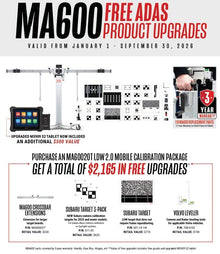
If you work mobile, a collapsible frame is the practical answer. The Autel MA600 packages and the Launch X-431 ADAS Mobile system fold down for transport and set up on site. If you work from a fixed bay and want alignment and calibration in one operation, the Autel IA900WA combines four-wheel alignment with ADAS calibration on a single frame.
The Autel IA700 sits between the two. It is modular, so you can start with the frame and add target packages as the vehicles you see demand them, rather than buying coverage you will not use for a year.
Autel or Launch Tech
Both cover the mainstream domestic, European and Asian brands. The practical differences are in how you buy coverage and how you expand.
Autel's range is the deeper of the two here, at 167 live products against 103. Its systems are built around target packages that step up in tiers, so an IA700AS all-systems package covers a much wider set of calibrations than an LDW-only package, and you can move between them by adding targets. Autel also offers digital targets on its higher-end frames, which replace physical boards with a screen.
Launch Tech tends to package more coverage into the base system. The X-431 ADAS Pro Plus line and the mobile packages are worth comparing directly against the Autel equivalents on the specific makes you actually work on.
If you service trucks and buses, both brands have commercial-vehicle answers: the Autel CVMALDW package covers light through heavy duty, and Launch offers a dedicated HD calibration tool.
Tablets, Targets and Software
A calibration frame is a positioning device. The tablet is what actually talks to the vehicle, so the tablet decides which vehicles you can calibrate.
Some tablets ship with ADAS software included, some take it as an upgrade, and some packages bundle a frame and tablet together at a better price than buying them separately. If you already own a compatible diagnostic tablet, check the tablets and subscriptions range for an ADAS software upgrade before buying a second tablet.
Targets are consumable in the sense that coverage expands. New model years bring new target patterns, and both manufacturers release them continuously. Browse Autel targets and accessories and Launch targets and accessories for individual patterns, lasers, reflectors, brackets and mounts.
Shop ADAS Calibration and Diagnostics
By brand: Autel, Launch Tech.
By type: Autel calibration systems, Launch calibration systems, Autel tablets and subscriptions, Launch tablets and subscriptions, Autel targets and accessories, Launch targets and accessories.
Doing the glass work as well? See auto glass replacement tools and windshield repair.
GT Tools® has been making auto glass tools since 1984. Our Products are Designed, Engineered, Forged, Machined, Assembled, and Shipped with pride in Durango, Colorado, USA.
Frequently Asked Questions
Does replacing a windshield require ADAS calibration?
If the vehicle has a forward-facing camera mounted to the windshield, then yes, in almost every case. The camera's aim is referenced to the glass it is bonded to, and new glass means a new reference. Repairing a chip or crack is different: a repair leaves the original glass and the original camera mount in place, so calibration is not normally triggered. Damage is repairable when a chip is smaller than a quarter, or a crack is less than 3 inches and not in the driver's line of sight.
What is the difference between static and dynamic calibration?
Static calibration happens in the shop with the vehicle stationary and a physical target placed at a manufacturer-specified position. Dynamic calibration happens on the road, with the vehicle driven at a set speed while the system calibrates against real lane markings. Which one applies is set by the vehicle manufacturer, not by the shop, and some vehicles require both procedures in sequence.
Do I need a wheel alignment system to calibrate ADAS?
Not for every calibration, but the two are more closely linked than they first appear. Radar and camera aim are referenced to the vehicle's thrust line, so a vehicle that is out of alignment can fail calibration or pass with a bad result. Combined alignment and calibration frames exist precisely because the two jobs keep landing on the same vehicle.
Can I use a diagnostic tablet I already own?
Possibly. Many diagnostic tablets can be upgraded to run ADAS calibration software rather than replaced. Check your specific model against the tablets and subscriptions range, because the upgrade path depends on the tablet generation.
How much space does static calibration need?
More than most shops expect. Requirements vary by manufacturer and by system, but you generally need a level floor, room to position a target several metres in front of the vehicle, clearance to either side, and lighting without strong shadows or reflections. Confirm the space requirement for the systems you intend to buy before committing to a bay layout.
What happened to the Autel 3.0 and IA800 packages?
Autel's naming has moved on. The systems previously sold as ADAS 3.0 packages and the IA800 positioning tool have been superseded by the IA700 modular frame and the IA900 and IA1000 alignment-and-calibration systems. Some IA800-era accessories, such as sliding panels and pattern-holder brackets, remain available and are still compatible with standard frames.