



YOUR CART IS EMPTY
Go to cart
Auto glass inventory has to live somewhere between delivery and installation, and how you store it decides how much of it survives. A glass rack holds windshields, back glass, and side glass upright in padded slots so pieces stay separated, off bare metal, and clear of shop traffic. The question for most shops is not whether to rack glass, but which format fits how the glass actually moves: mounted in a vehicle for mobile work, fixed in the shop for staging, or both.
This guide covers what to compare, how to load and secure glass safely, and how to size a rack to your inventory.
Start with the movement pattern, because it decides the format:
Vehicle-mounted racks for mobile technicians hauling inventory by truck or van. The rack bolts down and travels with the vehicle.
In-shop mounted racks for staging glass near a work bay or in a dedicated storage area. Fixed position, maximum stability.
A combination for shops running both mobile service and in-house installation, which is most shops of any size.
GT Tools glass racks are built for all three: they mount easily to any truck, van, or shop floor, which is what lets one rack design serve a mobile tech and a fixed bay.
The protective features that matter are the contact surfaces, the frame, and the securing mechanism. Treat each as an evaluation criterion rather than a guarantee, because a well-padded rack still depends on correct loading.
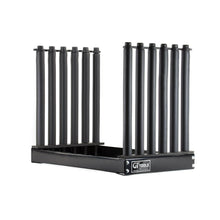
GT Tools racks are engineered with solid steel construction and three protective elements working together:
A high durometer wear-resistant rubber base. The glass edge sits on rubber rather than steel, which absorbs shock during transport and resists wear where the rack meets the floor or truck bed.
Dense foam-lined 22-inch steel posts. The posts give the structure; the foam sleeves keep glass faces and edges off metal and separate pieces from each other.
A locking hinge top with rubber tops. This is the part that matters most in a moving vehicle. Loaded glass is held in place rather than free to shift.
The frames carry a powder-coated finish over heavy-duty construction, and the racks are covered by GT Tools' Ironclad Lifetime Warranty.
Three slot counts cover most shop and vehicle needs. Prices are GT Tools list prices checked August 19, 2026.
|
Rack |
Slots |
Construction |
Securing |
Mounting |
Price |
|---|---|---|---|---|---|
|
5 |
Solid steel, powder coated, high durometer rubber base, dense foam-lined steel posts |
Hinge locking rubber top |
Truck, van, or shop floor |
$187.85 |
|
|
9 |
Same construction |
Hinge locking rubber top |
Truck, van, or shop floor |
$368.00 |
|
|
14 |
Same construction, dense foam-lined 22-inch steel posts |
Hinge locking rubber top |
Truck, van, or shop floor |
$578.00 |
The price ladder is close to linear per slot, so the decision is mostly about matching capacity to peak inventory rather than hunting for value at a particular tier. BYK-branded versions of all three are available at the same prices.
Count the windshields and glass pieces you hold at once on your busiest day, not a typical one. A rack that fits the average leaves you leaning glass against a wall on the day it matters, which is when breakage happens.
Windshields, back glass, side glass, and odd shapes all need to sit fully on the padded supports. Check that your largest pieces are properly seated between the foam-lined posts rather than overhanging.
A mobile technician's van rack and a shop staging rack solve different problems. The van rack sizes to a day's route; the shop rack sizes to inventory on hand. Many shops run a 5-slot in each vehicle and a 14-slot in the building.
Because these racks mount rather than roll, the install location is part of the purchase decision. For vehicles, confirm the mounting surface and the clearance around the loaded rack. For the shop floor, pick a spot out of traffic paths where a technician can load from either side.
GT Tools publishes a specific procedure for these racks, and the sequence matters:
Securely mount the rack to the truck, van, or shop floor using the provided mounting hardware.
Place each glass panel vertically between the dense foam-lined steel posts.
Make sure each piece is seated on the rubber base for shock absorption.
Use the hinge locking rubber tops to secure glass in place, preventing movement during transit.
Always strap glass to the rack before moving, to avoid shifting or breakage.
Inspect the rack and straps regularly for wear, replacing as necessary.
Step five is the one technicians skip on a short trip across town. The locking top holds position; the strap is what handles a hard stop.
GT Tools states these directly on its rack pages:
Always use two people to move large sheets of glass.
Never stand on the rack, and never attempt to restrain glass by hand.
Ensure glass is properly strapped before moving the rack.
Do not exceed the rack's slot or weight capacity.
Inspect the rack and all securing mechanisms before each use.
Maintain a tidy, hazard-free workspace around the rack.
Use appropriate PPE when handling glass.
The two-person rule is worth enforcing rather than treating as a suggestion. Most glass damage in a shop happens during handling, not storage.
Before each use: inspect the rack and all securing mechanisms. Check the foam sleeves for tears, compression, or exposed metal, and confirm the hinge locking tops close and hold.
Regularly: check the rubber base for wear, the posts and welds for looseness, and the mounting hardware for tightness, especially on vehicle-mounted racks that take road vibration. Check straps for fraying and replace as needed.
As needed: remove damaged equipment from service until repaired or replaced. A compressed foam sleeve that lets glass touch steel is a small problem until it is a broken windshield.
Set the exact interval as part of your shop's maintenance procedures. Vehicle-mounted racks generally need more frequent hardware checks than shop-floor units.
|
Scenario |
Recommended setup |
|---|---|
|
Mobile technician, single vehicle |
A 5-slot rack mounted in the truck or van |
|
Mobile service with higher route volume |
A 9-slot vehicle-mounted rack |
|
In-shop staging and storage |
A 14-slot rack mounted on the shop floor |
|
Mixed mobile and in-shop work |
Vehicle-mounted racks per truck plus a 14-slot in the building |
Size to your peak active glass count, not your average. GT Tools offers 5-slot, 9-slot, and 14-slot configurations at $187.85, $368.00, and $578.00 respectively. Mobile technicians typically size to a day's route; shops size to inventory on hand.
Yes. GT Tools racks mount easily to any truck, van, or shop floor, so the same model serves both. What changes is the mounting hardware and how often you check it, since a vehicle-mounted rack takes road vibration that a floor-mounted one does not.
Three things in sequence: the dense foam-lined posts separate and cushion the pieces, the hinge locking rubber top secures them in place, and a strap holds the load through braking and cornering. GT Tools directs you to always strap glass to the rack before moving it.
The high durometer wear-resistant rubber base gives the glass edge a shock-absorbing surface to sit on rather than bare steel, and the dense foam sleeves on the 22-inch steel posts keep faces and edges off metal.
GT Tools glass racks carry the Ironclad Lifetime Warranty. The standard terms extend coverage to hand and power tools against defects in workmanship and materials, with disposable and consumable supply items excluded.
Inspect the rack and all securing mechanisms before each use, and check hardware, welds, foam, and straps on a regular schedule set by your shop's maintenance procedures. Vehicle-mounted racks warrant more frequent hardware checks.
Match the format to how the glass moves, size to peak inventory rather than average, plan the mounting location before ordering, and enforce the strap-before-moving rule. Compare the 5-, 9-, and 14-slot GT Tools glass racks against your peak glass count and your vehicle fleet.
GT Tools has built professional auto glass tools since 1984, with racks designed for truck, van, and in-shop storage.