

YOUR CART IS EMPTY
Go to cart
Large glass is fragile, heavy, and prone to breaking when it is tilted flat, allowed to move, or handled by too few people. The central safety principle is simple: keep the sheet upright or near upright, protect every surface and edge from contact and vibration, secure it against sliding and tipping, and handle it with a properly sized team or suitable lifting equipment. Everything below follows from that.
Support each sheet in a purpose-built upright rack, cushion it, secure it, and move it with a controlled team.
Measure and inspect the sheet and the full route before touching the glass.
Use an appropriately sized glass rack instead of improvising support.
Keep the glass upright or near upright, because glass is strongest in its vertical plane.
Separate and cushion every surface and edge so panes never touch metal or each other.
Use two people for large-sheet manual movement.
Secure the sheet against sliding and tipping before the vehicle moves.
Drive smoothly, then inspect the load again before you unload.
A glass rack gives secure storage and transportation, reduces breakage risk, and lets a technician reach the correct panel without disturbing the others. GT Tools states the core safety rules for its racks directly: always use two people to move large sheets of glass, never stand on the rack or attempt to restrain glass by hand, ensure glass is properly strapped before moving, do not exceed the rack's slot or weight capacity, inspect the rack and all securing mechanisms before each use, keep a tidy and hazard-free workspace around the rack, and use appropriate PPE [1].
These three carry different risks, and each needs its own plan. A sheet you can carry briefly by hand may still need a rack and a tie-down system before it goes on a vehicle.
Carrying means manually moving one sheet over a short, unobstructed distance with direct support at the bottom and the side.
Carting means moving a sheet within a shop or jobsite using a rack or glass-moving equipment.
Vehicle transport means securing sheets to a rack or purpose-built vehicle support system for travel.
Maintain near-vertical orientation across all three. A slight lean is acceptable when the rack is designed for it.
Standard auto glass, large windshields, architectural glazing, and commercial panels can each need a different handling plan based on dimensions, weight, shape, edge condition, and available equipment. A commercial or oversized panel is not an ordinary auto-glass job when the team cannot control the load manually.
The two-person minimum for large sheets is the floor, not the ceiling.
Stop-work criterion: pause and bring in trained glass-handling support or appropriate lifting equipment whenever the panel cannot be safely controlled by the available people, the rack, the suction tools, or the vehicle tie-down points. Do not attach a universal size or weight number to that decision. Base it on the actual load and the actual crew.
Most avoidable glass injuries and breakage trace back to skipping this step. Verify each of these before you lift anything:
Sheet dimensions, approximate weight, and shape, and whether the panel is flat, curved, laminated, tempered, or already damaged.
The rack's slot count and weight capacity.
The vehicle's usable tie-down points and load area.
The path from storage to the vehicle, and from the vehicle to the destination.
Weather, wind exposure, road conditions, and whether a second person stays available through unloading.
Do not exceed the rack's slot capacity. Distribute glass evenly across the load and support it without pressure points, since concentrated pressure contributes to microcracks and deformation.
Stop and reconsider if the panel is cracked, an edge is damaged, the loading route is blocked, tie-down points are missing, the wind is high, or any equipment has not passed inspection.
A purpose-built rack holds glass in a controlled upright position and stops it moving during travel. That is exactly the job improvised supports fail to do.
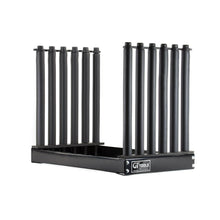
The GT Tools Glass Rack is engineered with solid steel construction, a high durometer wear-resistant rubber base, dense foam-lined 22-inch steel posts, and a hinge locking rubber top. It mounts to any truck, van, or shop floor using the provided mounting hardware, and it carries GT Tools' Ironclad Lifetime Warranty.
Size the rack to your inventory, not the other way around:
5-Slot Glass Rack, $187.85. The compact option, typically one per service vehicle.
9-Slot Glass Rack, $368.00. Mid capacity for higher route volume.
14-Slot Glass Rack, $578.00. The choice when you manage a larger inventory and need several panels organized at once.
The rack manufacturer's slot limits, mounting instructions, and securement instructions govern your setup. Follow the numbers printed for the rack you own.
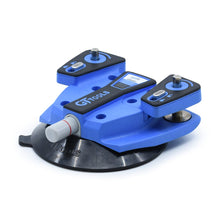
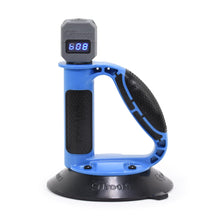
Suction cups help you grip and position glass. They do not replace proper support, team handling, a rack, or vehicle securement. GT Tools glass suction cups grip non-porous materials through a vacuum seal.
Match the cup to the panel shape, the load direction, and the rated capacity. The range runs from a 6-inch curved cup rated for 75 lbs at $77.00 up to a 10-inch curved cup rated for 300 lbs at $131.30, with 8-inch and 9-inch options between. Each rating applies only to that specific model, and it assumes a full, clean seal on a suitable contact area. Do not treat one cup's rating as proof that another cup handles the same panel.
Before use, inspect the cup pad, seal cleanliness, vacuum engagement, and handle operation, and confirm the rated capacity against your panel.
Decision point: if the panel cannot be controlled with manually operated cups and a two-person team, switch to appropriate lifting equipment or bring in a trained glass-handling professional.
Inspect before loading, again after the glass is secured, again after stops on a long trip, and once more before unloading. A load that was solid at the shop can loosen on the road.
Glass edges, corners, cracks, chips, and any existing damage.
Rack mounting, foam sleeves, rubber base, posts, locking tops, and overall structure.
Straps, hooks, anchor points, and tie-down routing.
Suction cup pads, seals, and handles where used.
Cut-resistant gloves and other appropriate PPE. Choose gloves with a non-marring palm so you keep grip without leaving marks on the glass.
GT Tools directs technicians to inspect the rack and all securing mechanisms before each use.
Direct glass-to-glass contact, hard contact with metal, road vibration, and concentrated pressure cause scratches, chips, and breaks. Protection stops those failures before they start.
Set up protection to do four things:
Separate individual panes so they never touch.
Cushion the contact points between glass and rack.
Protect exposed edges and corners.
Keep concentrated strap pressure off any unprotected edge.
On a GT Tools rack, the dense foam-lined posts handle the lateral cushioning and the rubber base absorbs shock at the glass edge. When you stack multiple sheets, place paper or thin foam packing sheets between them so panes cannot scratch or chip each other in transit.
For large sheets safe to handle by hand, a coordinated two-person lift is the default. Handlers should agree on the lift, keep the route clear, avoid sudden turns, and hold the bottom and side of the panel rather than gripping only the edge. Carry the sheet vertically with one gloved hand under the bottom and the other on the side.
Never restrain glass by hand while it is on a rack. If a panel starts to shift, do not grab it. That is how hands and glass both get cut, and GT Tools states the rule directly on its rack pages.
Warning: do not attempt a solo lift simply because suction cups are available. A cup gives you a handle, not a second set of hands.
GT Tools publishes this sequence for its racks, and the order matters:
Securely mount the rack to the truck, van, or shop floor using the provided mounting hardware, and confirm the vehicle is parked on stable ground.
Place each glass panel vertically between the dense foam-lined steel posts.
Make sure each piece is seated on the rubber base for shock absorption.
Use the hinge locking rubber tops to secure the glass, preventing movement during transit.
Always strap glass to the rack before moving, using rated tie-down straps at the vehicle's own anchor points. The rack does not include straps.
Verify by hand that the glass cannot slide, tip, contact another pane, or shift.
Step five is the one technicians skip on a short trip across town. The locking top holds position; the strap is what handles a hard stop.
Position racks lengthwise, parallel to the direction of travel, and route every strap so it secures the panel without bearing directly on an unprotected glass edge. Inspect the rack and straps regularly for wear, replacing as necessary.
A well-secured load can still fail if the vehicle adds excessive vibration, abrupt weight transfer, or impact. Choose a route that reduces harsh potholes, sharp turns, hard braking, and unnecessary high-speed travel where practical.
Stop and recheck the load after the first portion of the trip, after any hard bump or emergency maneuver, and whenever you suspect the glass has shifted. Treat that as operational judgment, not a fixed clock.
Unloading is its own risk point, because you remove straps and rack retainers while the glass may become unstable. Prepare a clear destination, staged support, and the same helpers or equipment you used to load.
Park and stabilize the vehicle.
Inspect the load.
Position helpers.
Maintain support on the panel.
Release restraints only when the sheet is under control.
Transfer it to its destination support.
Re-inspect the glass.
Keep the sheet upright or near upright through unloading and into storage. Stop if the footing is unstable, the wind picks up, a helper is missing, a strap is damaged, or the panel appears to be binding or shifting.
Correctly mounted glass rack sized to the load.
Rated tie-down straps and verified vehicle anchor points.
Foam, rubber, or paper separation and cushioning materials.
Edge and corner protection.
Appropriate PPE, including cut-resistant, non-marring gloves.
Inspected suction cups rated for the panel.
A clear route and prepared unloading support.
A second trained handler or suitable lifting equipment.
Do not exceed the rack's slot or weight capacity.
Do not move large sheets alone when two-person handling or lifting equipment is needed.
Do not transport glass loose, unstrapped, or able to contact another pane.
Do not restrain a shifting panel by hand while it is on a rack.
Do not stand on a glass rack.
Do not use damaged, worn, dirty, or unrated handling and securement equipment.
Do not treat one cup's rated capacity as proof that every cup can manage the same panel.
Do not proceed if weather, route, crew availability, or equipment condition prevents controlled handling.
Before departure:
Rack mounted correctly and within slot and weight capacity.
Glass seated fully on the rubber base and cushioned at every contact point.
Hinge locking tops engaged and straps routed off unprotected edges.
Anchor points verified and load stable under manual check.
Route, weather, and unloading access confirmed.
Before unloading:
Vehicle parked on stable ground.
Glass condition inspected.
Destination support staged and path clear.
Team ready and equipment inspected.
Restraints released only once the sheet is fully supported.
Two is the minimum for large-sheet manual handling, and GT Tools states that rule directly for its racks. Larger, heavier, awkward, or commercial panels often need trained personnel and lifting equipment rather than simply more hands, because extra people do not solve a load that exceeds safe manual control.
Seat each panel vertically between the foam-lined posts and on the rubber base, close the hinge locking rubber top, then add rated tie-down straps at the vehicle's own anchor points. The locking top holds the glass in position; the straps handle braking and cornering. GT Tools racks do not include straps, so source them separately.
Gripping glass and securing it for travel are two different jobs. Suction cups hold non-porous material through a vacuum seal, which helps you move a panel into position, but they are not a securement system for driving. Use only cups rated for the specific panel and lifting orientation.
Match it to panel weight with margin, and confirm the cup seats fully on the available contact area. GT Tools' vacuum cups run from 75 lbs on the 6-inch curved model to 300 lbs on the 10-inch curved model. Ratings assume a full, clean seal, so treat them as a ceiling under ideal conditions rather than a working target.
Keep glass off bare metal by seating it on the rubber base and between foam-lined posts, separate stacked panes with paper or thin foam, and route straps so they never press against an unprotected edge.
Large commercial panels can exceed the control limits of ordinary manual handling. They usually call for a formal lift plan, suitable rack support, rated lifting equipment, and trained personnel. When a panel cannot be held under full control by the crew and tools on hand, treat it as a professional lift rather than a routine two-person carry.