

YOUR CART IS EMPTY
Go to cart
A cracked windshield gets replaced, but a scratched one gets thrown away far too often. Full glass replacement is a significant expense, while professional scratch removal costs a client a fraction of that and returns solid margin to the technician. For professional detailers and glaziers, glass scratch removal tools turn a job most shops decline into a repeatable, high-value service. GT Tools has manufactured glass restoration solutions in the USA for over 40 years, and this guide walks through the full process.
Before you touch a disc to glass, you have to know what you're working with. The severity of a scratch determines whether it can be ground out, polished away, or whether the pane is beyond saving.
The fastest field assessment is the fingernail test. Drag a fingernail across the scratch, perpendicular to the mark.
If your nail catches in the groove, the scratch is deep enough to require an abrasive resurfacing system. These scratches have removed measurable glass and need to be physically ground level.
If your nail glides over without catching, you're dealing with a surface scuff, haze, or fine wiper marks. A polishing compound will restore clarity without grinding.
Scratches deeper than roughly .015 of an inch, or any damage crossing the driver's primary line of sight on a windshield, may fall outside the safe repair range. When the groove is too deep to level without thinning the glass beyond spec, replacement is the correct call. Everything shallower is a candidate for repair.
Repair is where the numbers favor both the technician and the client. Professional scratch removal typically runs a client a few hundred dollars against the significant cost of replacement, and glaziers using established systems recover up to 95% of panes that would otherwise be scrapped, according to GlassRenu's system data via NFK [1]. WCR reports similar recovery rates of 75 to 95 percent using a comparable dry-grind process [2].
For a shop, adding scratch repair is a straightforward revenue play. As Mobile Tech RX puts it, "Having a scratch repair kit allows shops to offer an additional service and increase their revenue per job." GT Tools offers a full range of glass scratch repair kits built to capture exactly that work [3].
There are two distinct methods for removing marks from glass, and picking the wrong one wastes time or leaves the job unfinished. The difference comes down to whether you are removing glass or only refining its surface.
Abrasive systems physically level the glass. They use multi-stage grinding with progressively finer discs to grind down the surrounding surface until it's flush with the bottom of the scratch, then work back up through finer grits to remove the resulting haze. This is the only method that removes a scratch you can catch a fingernail in.
Abrasive resurfacing is the technology behind kits like the Scratch Hog. It handles the heavy work: wiper gouges, razor marks, welding slag, carbide scribe lines, and sandpaper scuffing.
Polishing uses a compound to remove very fine surface scratches, water spots, oxidation, and haze. It refines the surface at a microscopic level rather than removing bulk glass. A cerium oxide glass polishing kit for deep scratches is not a substitute for grinding. The polishing compound is the final step after abrasive work on a deep scratch, restoring optical clarity to the ground area, or the only step needed for very light marks that never caught your nail.
GT Tools' glass polishing compounds are made in the USA and used by collision shops, glass professionals, and detailers to restore clarity to windshields, laminated glass, and tempered glass.
Cerium oxide restores optical clarity through chemical-mechanical polishing. It's not just a fine abrasive. The cerium reacts with the silica in the glass surface, softening a thin molecular layer while the mechanical action of the polishing pad removes it evenly. This combined chemical and mechanical effect polishes the surface flat at a scale far finer than any grinding disc can achieve, which is why it leaves a clear, distortion-free finish rather than a hazed one. The abrasive discs remove the scratch; the polishing compound gives the glass its transparency back.
The single biggest failure in glass scratch removal is trading a scratch for a lens. Grind unevenly and you create a low spot that bends light, producing optical distortion that's often worse than the original mark, especially on a windshield in the driver's line of sight.
GT Tools systems are built to prevent that. The Scratch Hog and Scratch Magic Premium use SpeedGrit™ Technology, a foam-core disc that removes scratches efficiently while minimizing operator error and swirling. The foam backing lets the disc conform slightly to the glass, spreading pressure and reducing the risk of digging a distorted low spot.
The Scratch Hog Standard is tested distortion free, which is the standard that matters most for automotive windshields and architectural glass. Distortion-free performance is what separates a professional system from a hardware-store polishing kit. Competitors position around the same goal; GlasWeld UK, for example, markets its G Force system as producing "distortion free results with no optical deviation."
Water management plays a role here too [4]. Center water-feed mechanisms found on professional deep-grinding systems continuously cool and lubricate the contact point, flushing away glass dust and preventing the heat buildup that can crack or cloud the pane during aggressive removal. Keeping the glass cool and wet through the grinding stages protects the surface and ensures consistent, high-quality results throughout the repair.
The systems are simple to run. Both the Scratch Hog and Scratch Magic Premium are designed so a technician gets clean results by following the process, with manual control over pressure and pass direction rather than fighting the tool. GT Tools builds this equipment for daily professional use, and every order ships free under an ironclad warranty.
The process below mirrors the workflow used by leading glass restoration pros, condensed into five stages. The Ultimate Guide from SD Glass Restoration lays out the same sequence: identify depth, grind at controlled RPM, feather, progress through finer grits, and finish with a polishing compound [5].
Clean the glass thoroughly with a lint-free cloth and glass cleaner. Any grit trapped under the disc will cut fresh scratches into the surface you're trying to save. Once clean, mark the scratch on the opposite side of the glass with a marker or grease pencil so you can track its location without the mark washing away as you work.
Skip this step entirely for marks that don't catch a nail. For deeper scratches, select your starting grit based on depth. A deep gouge starts coarser; a shallow catch starts finer.
Run a true rotary polisher at a controlled 1000 to 1800 RPM. Random orbital or DA sanders will not produce even, swirl-free results. Keep the disc flat against the glass and work in overlapping, cross-hatch passes so you level the area rather than digging a channel. Feather the edges of the worked area by gradually lightening pressure and widening your passes outward. Feathering blends the ground zone into the surrounding glass so no visible step or low spot forms, which is what prevents lens-like distortion. Monitor glass temperature constantly and keep the surface wet.
Grinding leaves a frosted haze. Work through progressively finer grits to clear it, following a typical progression of 180 to 360 to 500 to 1000. Each finer disc removes the scratch pattern left by the one before it. Clean the glass completely between every grit change. A single coarse particle carried into a fine stage will streak the whole surface and force you to start over.
Mix the polishing compound with water into a smooth slurry, roughly the consistency of light cream. Apply it to a felt polishing pad and work it over the pre-polished area to bring back full optical clarity. Keep the surface cool and damp throughout; if the slurry dries out, it stops cutting and can scuff the finish. This is the stage that transforms a frosted, ground patch back into transparent glass.
Clean the glass and inspect it from multiple angles against a bright light source. Look for residual haze, swirl marks, or any distortion when you shift your viewing angle. Check the repaired area against the surrounding glass for clarity and flatness. If any haze remains, return to the polishing step. When the light reflects cleanly and the scratch is gone with no visible distortion, the job is done.
A typical light scratch takes a few minutes to polish out. A deep scratch requiring the full grind-and-polish sequence usually runs 20 to 45 minutes depending on depth and area.
Different damage comes from different sources and calls for a different starting point. Use this to match the scratch to the right approach and GT Tools product.
|
Scratch Type / Cause |
Depth |
Method |
Starting Grit |
Finish |
GT Tools System |
|
Water spots, oxidation, haze |
Surface only |
Polishing |
None |
Diamond Fast Powder |
|
|
Light wiper marks, fine scuffs |
Under .003" (no nail catch) |
Light abrasive + polish |
Fine |
Polishing compound |
|
|
Razor blade, moderate scratches |
Nail catches |
Multi-stage abrasive + polish |
360–500 |
Polishing compound |
|
|
Carbide scribe, welding slag, sandpaper |
Up to .015" |
Full multi-stage abrasive + polish |
180 |
Polishing compound |
Scratch Hog Standard |
Matching the kit to the damage is how you buy commercial grade glass repair equipment without overspending or coming up short on a job.
The Glass Polishing Kit handles water spots, fine scratches, and haze that don't catch a fingernail. It includes a half pound of Diamond Fast Powder, a 5-inch felt pad, backing pad, and spindle adapter, and runs off a standard power drill at around 1500 RPM. It works by hand for small touch-ups too. This is the entry point for restoring dull windows and lightly hazed glass.
The Scratch Magic Premium uses SpeedGrit™ foam-core discs to remove scratches less than .003 of an inch deep, the ones you can't catch a nail in, along with hazing, staining, corrosion, and minor wiper scratches. The design minimizes operator error and swirling, and it runs off a 110V drill at a minimum of 1500 RPM. It's a practical addition for any detailing operation looking to add glass work to its service menu.
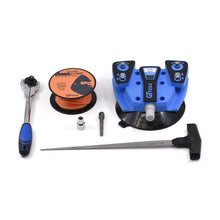
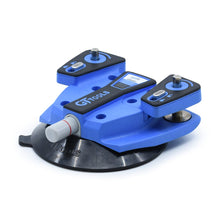
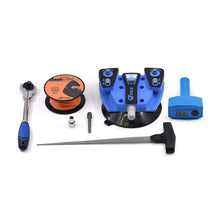
The Scratch Hog Standard offers the broadest repair range in the industry, removing everything from heavy scratches up to .015 of an inch deep down to the lightest surface damage. Tested distortion free, it comes with the Scratch Hog machine, tech case, foam and felt pads, Liquid Diamond Polish, polish with mineral remover, and anti-stain solution. This is the system for professionals taking on carbide scribe marks, welding slag, and deep gouges.
Compared against competitor systems like RevoGlas and the GlasWeld Gforce Max XL marketed for mobile techs and vintage car restorers, GT Tools' lineup covers the same deep-scratch capability with a simpler, drill-driven workflow that's easy to adopt and straightforward to run on any job site [6] [7].
GT Tools systems work across the same range of glass that leading systems handle. That includes automotive glass (laminated windshields and tempered side and back glass), architectural flat glass, storefront and shopfront glass, balustrades, windows, and doors. Competitor systems confirm the breadth of the category: the PRO system from Glass Polish Shop lists laminated, tempered, annealed, fire-rated, mirrored, and automotive glass as suitable surfaces (patterned and textured glass excepted), and the GlasWeld XL kit covers auto, flat, tempered, and storefront glass [8] [7].
Because the equipment is drill- and polisher-driven and portable, it works on the job site as readily as in the shop. Mobile auto glass techs, glaziers on a storefront call, and detailers in a bay all run the same process.
Nearly all of them. Automotive laminated windshields, tempered auto glass, architectural flat glass, storefront glass, and mirrors are all repairable. GT Tools compounds are formulated to restore clarity to windshields, laminated glass, and tempered glass. Patterned or heavily textured glass is generally not suitable because the surface can't be ground flat.
Yes. A professional multi-stage abrasive system like the Scratch Hog is tested distortion free. The key is even grinding, working through the full grit progression, and feathering the edges of the worked area so the repair blends into the surrounding glass rather than forming a low spot.
For the polishing stage, a high-purity cerium oxide compound is the best liquid compound for fixing scratched glass. GT Tools' Diamond Fast Powder mixes into a slurry that restores optical clarity after abrasive work or removes very fine surface scuffs on its own. For deep scratches, the compound is the finishing step, not the whole repair.
No formal certification is required. Professional systems are designed for straightforward use, and following the step-by-step process carefully is what produces good results. GT Tools kits ship with instructions, and the drill-driven workflow is manageable for a technician new to glass restoration. Several competing systems, including GlassRenu via WCR, note that no formal training is needed to operate their dry-grind process [2].
Both. The equipment is portable and runs off a standard drill or rotary polisher, so mobile auto glass techs and field glaziers use it on location just as easily as a shop uses it in a bay.
It's a high-margin add-on service. You save clients the significant cost of full glass replacement, capture the difference as profit, and position your operation as a full-service provider. For most shops it's a fast return on the equipment investment. Explore the full range on the glass polishing and scratch removal overview page or the GT Tools homepage.